
Implementing Augmented Analytics and NLP Full Guide
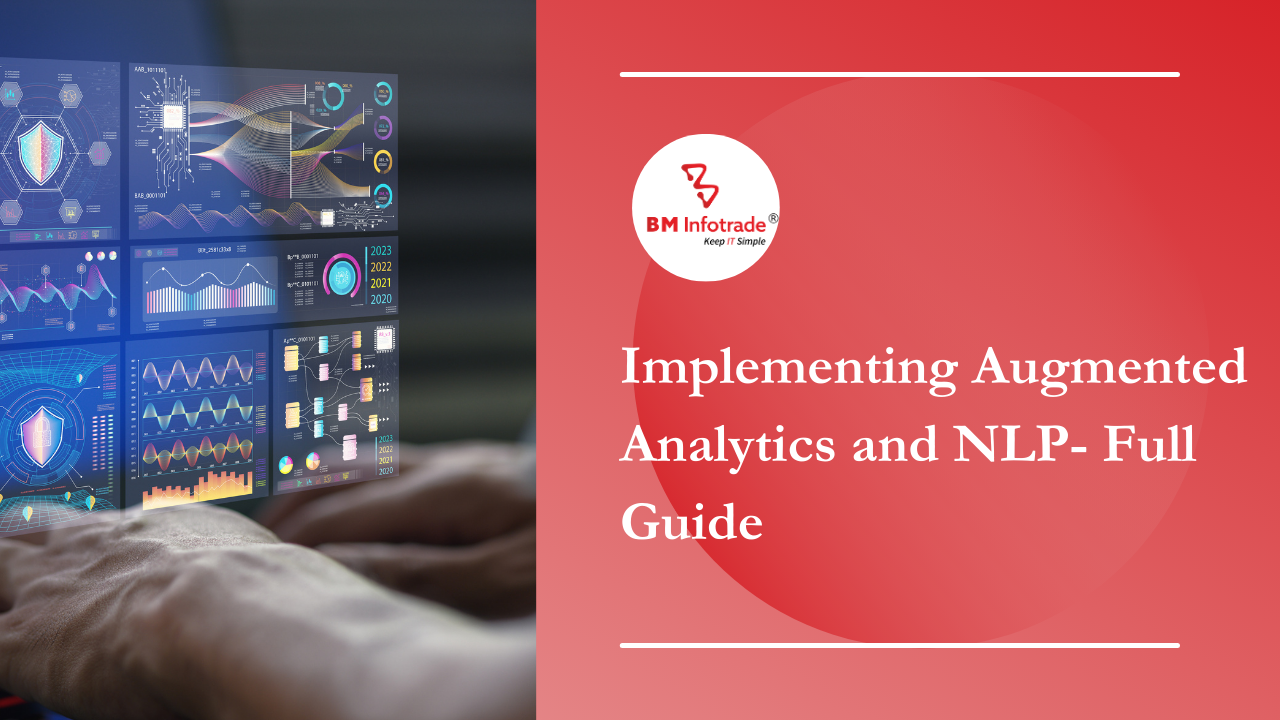
This complete guide explains how Augmented Analytics and Natural Language Processing work together to automate data analysis, generate insights in real time, and enable smarter, faster business decisions using AI.
08
Dec
Implementing Augmented Analytics and NLP Full Guide
Table of Contents
Today's business environment is inundated with data from customer interactions and transactions, IoT sensors, and all types of social media data. The issue is no longer about collecting data, but about developing it into something meaningful and profitable. Augmented analytics and Natural Language Processing (NLP) will help businesses, in 2026, turn that raw, unstructured data into data that provides clear and actionable insights that drive revenue.
This blog will discuss implementing augmented analytics, using NLP algorithms for business, developing predictive analytics models, and data storytelling for providing actionable recommendations and improved assumptions.
The Rise of Augmented Analytics
Augmented analytics is transforming how businesses leverage data. Rather than relying on data scientists to manually model and interpret data, as is the practice today with traditional analytics, augmented analytics uses Artificial Intelligence and machine learning to automate data preparation, analysis, and the generation of insights.
By 2026, organisations will use augmented analytics to not only understand the past, but to anticipate the future. With automated data insights, leaders will be able to respond to market fluctuations, provide tailored experiences for customers, and optimise operations promptly.
Some benefits of augmented analytics include:
1. Fast to Insight: Automated analysis shortens the time from collecting data to making decisions.
2. Democratising Analytics: Business users can query the data in a non-technical manner.
3. Predictive Capabilities: The machine learning models detect patterns and symptoms, providing potential future behaviours.
Natural Language Processing (NLP) in Business Intelligence
A major advancement is making use of Natural Language Processing (NLP) specifically for business intelligence (BI) applications. An NLP-enabled user may simply say something like: "What were our best business regions last quarter?" and they will receive instant visual, actionable responses.
By 2026, NLP algorithms for business will have even greater context awareness to help the user capture complex queries, synonyms, and sentiment found in customer feedback. Overall, this has made much more logical data storytelling and has empowered non-technical teams in graduate marketing, accounting, and operations to arrive at their own insights and conclusions more often, separate from technical or analytics teams.
Step-by-Step Guide to Implementing Augmented Analytics
Implementing augmented analytics is not just a technology upgrade — it’s a cultural shift. Here’s how businesses can get started:
1. Define Your Data Monetisation Strategy
The first step is to determine how your data may be turned into a source of revenue. Perhaps it is improving operational efficiency, personalising customer journeys, reducing churn, or developing innovative products built on data.
2. Choose the Right BI Platform
Choose a BI platform that enables AI-driven data analysis, natural language processing (NLP) interfaces, and predictive analytics models. There are some great offerings in 2026 that connect easily to cloud data warehouses and provide drag-and-drop dashboards.
3. Automate Data Preparation
Successful analytics is underpinned by access to structured and clean data. Use tools that can automatically cleanse, enrich, and transform data execution pipelines.
4. Build Predictive Analytics Models
Utilise machine learning algorithms to predict customer behaviours, demand change, or risk appetite. A model will encourage decision-makers to be proactive rather than react based solely on qualitative data.
5. Empower Business Users with NLP
Empower your teams to ask questions of their data by training them to use BI tools that incorporate NLP. It will guarantee that you free up your data teams from bottlenecks so they can turn data into actions faster.
6. Focus on Data Storytelling
Translate complicated insights into gripping narrations that are easy to comprehend. Great data storytelling resolves the gap between the data scientists and the executives who consume the data as stories.
7. Measure ROI and Iterate
Finally, revisit KPIs like revenue growth, cost savings and speed of decision making to confirm whether this is paying off. Adopt a continuous performance practice in a refinement cycle.
Contact:- sales@bminfotradegroup.com +919314508367 +919829189200
Predictive Analytics Models: Turning Insight into Foresight
At the centre of augmented analytics are predictive analytics models. Predictive analytics models use historical data to derive likely future results. For example:
1. Retail: Predicting seasonal demand for improved inventory management.
2. Finance: Predicting early signs of loan default risk.
3. Healthcare: Predicting patient readmission rates.
4. Manufacturing: Predicting equipment failures before they happen.
In 2026, new models will employ reinforcement learning, which produces continuous improvement to predictive accuracy over time.
NLP Algorithms for Business: The Human Touch in AI
NLP introduces human interaction with data. Instead of learning SQL or complex Business Intelligence, users type or speak the questions they want answers to.
Modern NLP algorithms do more than just keyword matching. They:
1. Recognise context and intention.
2. Facilitate multi-turn conversations with follow-up questions.
3. Create natural language summaries based on what is displayed in dashboards.
4. Run sentiment analysis on customer reviews.
5. It makes analytics more usable and actionable for everyone.
Data Storytelling: Driving Action with Insights
Analysing data is only helpful if it stimulates some sort of action. Data storytelling refers to the way in which businesses turn their numbers into compelling narratives that lead to decisions.
Rather than drowning stakeholders in complex data visualisations, the company should tell a story instead:
What happened? (Descriptive Analytics)
Why did this happen? (Diagnostic Analytics)
What will happen next? (Predictive Analytics)
What action should we take? (Prescriptive Analytics)
Using this sequential approach ultimately leads to actionable recommendations so that organisations can use analytical data and momentum for meaningful purposes.
Contact:- sales@bminfotradegroup.com +919314508367 +919829189200
Conclusion
In the year 2026, the blend of augmented analytics, Natural Language Processing (NLP), and Artificial Intelligence (AI)-leveraged data analytics is not a thing of the future - it is now a competitive imperative. Companies leveraging augmented analytics, NLP, and AI-driven data analytics are able to access new avenues for data monetisation, faster decision-making, and greater growth.
Organisations can turn data 'raw material' into a strategic asset to enable revenue generation via a formal business intelligence (BI) implementation roadmap, automated insights on data, and data storytelling.
FAQs
Q1. What is augmented analytics, and why is it important in 2026?
Augmented analytics utilises AI and ML to simplify data understanding, analysis, and actionable insights. In 2026, it’s significant because while data is becoming more abundant, augmented analytics assists teams on time, increases decision-making speed, and makes data analytics available for all employees instead of just data professionals.
Q2. How does NLP improve BI implementation?
Natural language processing (NLP) enables every user to ask questions in English using either typing or speaking, and then immediately get either a dashboard or a report. This helps clarify data analysis tools, thereby enabling more employees to transition into using data to make decisions.
Q3. Can augmented analytics really help with data monetisation?
This is true — we can leverage data, including forecast models, to discover hidden opportunities to grow revenue, personalise customer experiences, improve demand, or remove inefficiencies — thus benefiting the bottom line and profitability.
Q4. What is data storytelling, and why is it necessary?
Data storytelling allows businesses to represent their charts into narratives that are concise and can be read by others — explaining what occurred, why it is significant, and what to do next, thus creating actionable insights for everyone.
Q5. How do predictive analytics models support decision-making?
This is based on historical data - to forecast, or predict, future outcomes in terms of sales, churn, or failures to shift decisions from reactive, or being further away from the event, to procedural, or being close to the event.


Anshul Goyal
Group BDM at B M Infotrade | 11+ years Experience | Business Consultancy | Providing solutions in Cyber Security, Data Analytics, Cloud Computing, Digitization, Data and AI | IT Sales Leader