
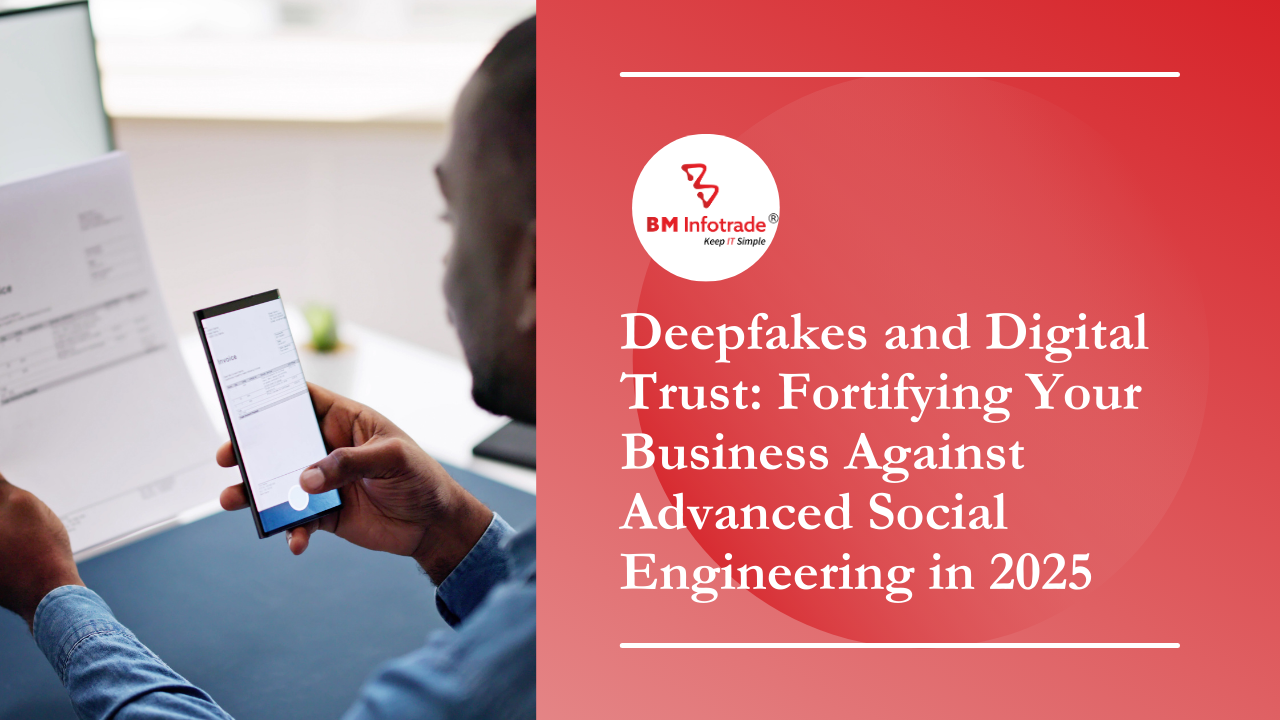
Deepfakes and Digital Trust: Fortifying Your Business Against Advanced Social Engineering in 2025
Deepfakes are now powerful enough to impersonate CEOs, bypass security checks, and manipulate employees. In this video, we uncover how these attacks happen, why 2025 will see a massive rise in AI-powered social engineering, and what businesses must do to protect digital trust.
05
Dec
Deepfakes and Digital Trust: Fortifying Your Business Against Advanced Social Engineering in 2025
In this article
In 2025, businesses will be confronted with a cybersecurity battleground that we have never experienced before. Deepfakes and AI-based cyberattacks are no longer a threat that exists in the distant future - they are here, they are advanced, and they are remarkably realistic. Cyberattackers are abusing trust at a psychological level, from impersonating a CEO on live video calls to voice cloning for business email compromise (BEC) scams. In this terrain, digital trust becomes a business-critical asset, and companies need to take action to secure it. This article discusses the steps you should consider to identify deepfakes, deter advanced social engineering, and implement zero-trust security frameworks that can protect your organisation's most important asset - trustworthiness.
Contact:- sales@bminfotradegroup.com +919314508367 +919829189200
The Rise of Deepfakes as a Cybersecurity Threat
Deepfake technology has progressed to the level that, for the average person, it is impossible to distinguish between real and fake. Bad actors are now using deepfake video calls to trick employees into sending money, divulging sensitive information, or authorising unauthorised access. By 2025, deepfakes will be used as weapons for corporate espionage, stock market manipulation, and attacking the reputations of the public.
Why This Matters for Businesses
A single deepfake-enabled fraud can cost millions in direct losses. Deepfakes undermine employee trust, which degrades decision-making and productivity. A brand's reputation can be impacted overnight if fake media goes viral before fact-checking catches up. This is why deepfake detection technologies driven by AI pattern recognition are now critical and not optional.
Advanced Social Engineering: The New Corporate Nightmare
Social engineering has always relied on manipulating human psychology, but by 2025, it has evolved into a high-tech phenomenon. Threat actors are using a mix of voicemail phishing (vishing), false chatbots, and live deepfake videos to bypass even well-trained employees.
The following examples of advanced social engineering attacks illustrate:
1. Synthetic CEO Scams: Deepfake video calls asking to transfer money urgently.
2. AI-Generated Emails: Perfectly worded BEC scams that simulate an email from your CFO.
3. Fake Vendor Portals: Cloned websites tricking employees into providing login credentials.
These attacks are not just technical attacks; they are psychological attacks that utilise urgency, fear, and authority to circumvent our rational thinking.
Contact:- sales@bminfotradegroup.com +919314508367 +919829189200
Building Digital Trust: The Core of 2025 Cybersecurity
Organisations should make digital trust a priority as they seek to thrive in this ecosystem. Digital trust is the ability to act and engage, confident that data, identity and communications are true, accurate and secure.
Ways to foster digital trust:
1. Leverage deepfake detection tools for use with video and voice content.
2. Use effective identity and access management (IAM) tools and ensure multi-factor authentication is included.
3. Take advantage of biometric features where identity spoofing can be decreased.
4. Quickly confirm any communication with vendors and partners on a secondary channel.
5. Digital trust should be a topic of discussion with the board for review, not simply an IT-related discussion.
Zero Trust Security: Your Best Defence
The zero trust security model is beyond being just a catchy phrase — it is the foundation for 2025's cybersecurity strategy. The tenets of zero trust are that no user or device is trusted by default, whether they are within the network or outside the network.
Practical steps to move to zero trust:
1. Authenticate everything: Make use of continuous authentication with behaviour analytics.
2. Isolate your environment: Limit lateral movement should an attacker gain entrance to the environment.
3. Monitor in real-time: AI-powered monitoring is able to identify anomalies that occur in real-time.
4. Least privilege access: Employees should have access only to what they actually need.
Zero trust + AI-based monitoring significantly lowers the chances of successful intrusion events, especially those enabled with deepfake infiltration.
Employee Security Training: The Human Firewall
Technology by itself will not combat advanced social engineering. Employee awareness is still your first line of defence. In 2025, security training must shift away from the traditional means of employing phishing simulations, in favour of:
1. Exercises on deep fake recognition (identifying subtle visual and audio irregularities).
2. Vishing simulations that train employees to solicit verification during suspicious voice calls.
3. Psychological resilience training can be taught to resist acts of manipulation (EMAR).
4. When employees understand how deep fake media works, they will feel empowered to ask questions about suspicious communication — even if it looks or sounds “real.”
Contact:- sales@bminfotradegroup.com +919314508367 +919829189200
The Role of Biometric Authentication
Deepfakes are becoming harder to spot with the naked eye, so businesses should think about using biometrics as an extra layer of security. Biometrics can be facial recognition, voiceprint verification, and even behavioural biometrics (like typing patterns or mouse movements) to verify users in real-time. However, businesses must pair biometrics with ethical data storage and legal compliance for privacy to gain the customer's trust.
Conclusion
The cybersecurity landscape will continue to be formidable in 2025 and after with deepfakes and sophisticated social engineering attacks. Successful companies will continue to invest in digital trust, employ zero trust security, and build a workforce in which all employees actively participate in defending against threats as part of their day-to-day work. In an organisation's effort to cultivate resilience in this new era of uncertainty, deepfake detection, IAM, biometrics, and ongoing employee training will provide significant augmentation.
FAQs
Q1: Deepfake Detection & Importance
Deepfake detection leverages artificial intelligence tools to detect fake or altered audio, video, and photographs. Deepfake detection is important because it protects organisations from fraud, identity theft and scams while maintaining the trust that is afforded digitally.
Q2: Advanced Social Engineering vs Phishing
Phishing relies on simple fake emails, while social engineering can use sophisticated deepfake videos and AI-generated voice and can launch a live attack by mimicking appearance and voice. More realistic and hence difficult to detect phishing and social engineering attacks can manipulate information much more easily.
Q3: Zero-Trust Security Role
Zero Trust philosophy focuses on never trusting anyone and constantly verifying user identity, where access may be restricted, and it looks for behaviour in network activity where an attacker may enter if they compromise credentials.
Q4: Protecting Against BEC Scams
Utilise multi-factor authentication (MFA), secure email gateways, and an Identity Access Management (IAM) solution. Train your staff to verify high-value transactions, and consider arranging a phone call or an in-person meeting as justification to approve.
Q5: Biometric Authentication vs Deepfakes
Biometrics can be less risky than using passwords, but still could be spoofed. Use liveness checks or behaviour monitoring in conjunction with baseline biometrics and zero-trust security.




Anshul Goyal
Group BDM at B M Infotrade | 11+ years Experience | Business Consultancy | Providing solutions in Cyber Security, Data Analytics, Cloud Computing, Digitization, Data and AI | IT Sales Leader